


In the 2000s, you couldn’t walk into a bookstore without seeing Life of Pi face-out near the cash registers. The Barnes & Noble logo may as well have been a Bengal tiger on a lifeboat. Even before Ang Lee’s film adaptation put it back on the bestseller list, Yann Martel’s earnestly spiritual novel about a boy’s search for God sold nearly 10 million copies.
But despite a $3 million advance from Random House, Martel’s next book, Beatrice and Virgil, a Holocaust allegory starring a taxidermied donkey and monkey, flopped with critics and readers. The High Mountains of Portugal, a novel in stories about three widowers, didn’t fare much better.
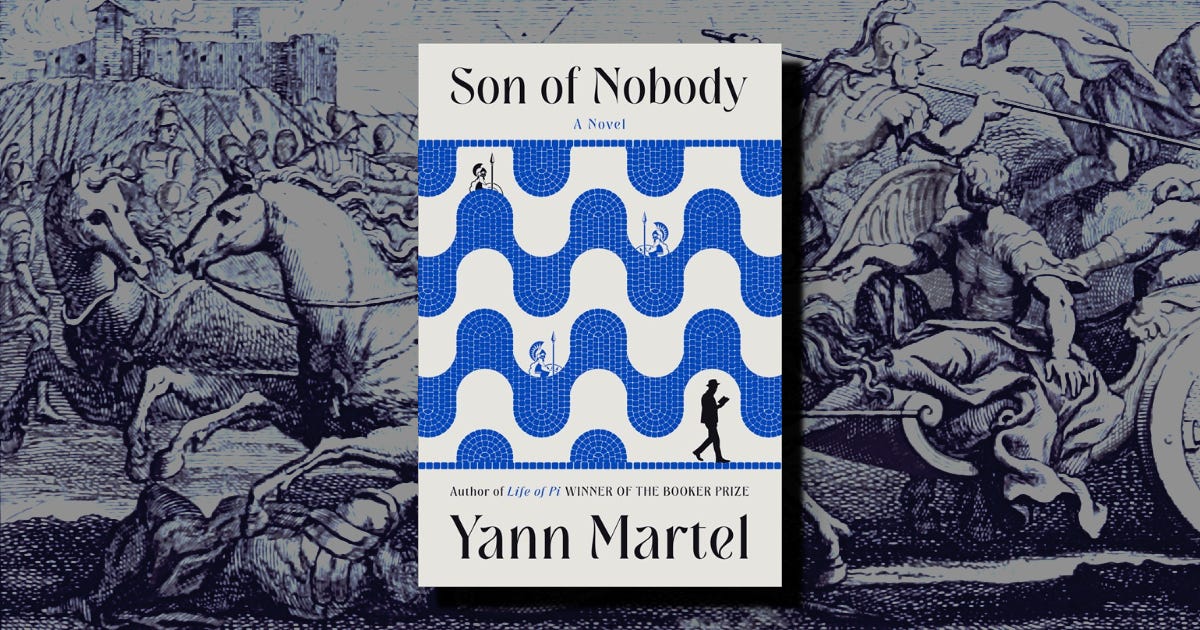
Could Martel’s new novel, Son of Nobody, be another big hit?
The premise is irresistible. After leaving his wife and daughter behind in Canada, a Homeric scholar named Harlow Donne discovers The Psoad, a lost epic poem about the Trojan War, scribbled on ancient papyrus leaves. It retells the events of The Iliad through the eyes of a common soldier, Psoas, as opposed to the kings, heroes, and gods who dominate Homer’s version.
Instead of a traditional novel, Son of Nobody is formatted like a publisher’s translation of epic poetry. The top half of each page is reserved for lines from The Psoad and the bottom half for Donne’s footnotes, which alternate, sometimes awkwardly, between illuminating the text and telling a personal story to his daughter, Helen.
If you’ve ever read The Iliad, or even just watched Wolfgang Petersen’s woefully underappreciated popcorn adaptation, The Psoad is occasionally fascinating. Martel’s description of the city of Troy, for instance, is more detailed and evocative than Homer’s.
The walls of Troy, so high, so bright, so final,
built by the hands of Apollo and Poseidon,
they say. The godly touch was plain to see.
Most impressive of all were the mosaics,
vaster than the sails that had brought us to Troy.
Such beautiful images on so grand a scale
were unknown to us, showing gods and kings of such
proportions that had they deigned to reach down,
they could have picked up one of our warships.
Those facing water stood proud and martial,
set for war, while those facing land lay in gardens,
garlanded with flowers, cups of wine in hand,
reposing to the music of lutes and lyres,
or hunting stags and lions, arrows flying.
We never really get the “People’s Iliad” promised by the novel’s setup, but there are new working-class characters, new battle tactics, and a surprisingly prominent role for Hades, who barely appears in The Iliad. There is also the mystery of The Psoad’s authorship, for which Martel offers a clever solution. If you’re a Homer nerd who devoured Emily Wilson’s new translations, this kind of stuff is catnip.
But in the end I think Emily Wilson (forgive me for presuming) would throw this book across the room. As a writer of fiction, Martel has always been more interested in answering questions than asking them. Like other fast-food philosophical novels for the undiscerning masses — Paulo Coelho’s The Alchemist, Matt Haig’s The Midnight Library, Fredrik Backman’s A Man Called Ove, and Life of Pi — Son of Nobody tries to simulate spiritual enlightenment through a hero’s journey that culminates in quotable truisms and eye-rolling clichés.
In the text of The Psoad, when Hades witnesses the death and destruction of the Trojan War for the first time, he says — I kid you not — “Why can’t we all just get along?” A few lines later, the Lord of the Underworld teaches Psoas about the mental health benefits of regular exercise. “My body, after spending / so much, finds itself with even more to spend. / And my mind is refreshed, having taken a rest / from its driven ways.”
In the footnotes, Harlow Donne frequently slips into Coelho mode. “Gail was a book I never wanted to close,” he croons. “I loved Gail like a scribe loves a bard, like a candle loves a flame, like history loves the past, like a tongue loves speech, like a baby loves a honey-dipped finger.”
I won’t spoil Son of Nobody’s twists, but both stories — ancient and contemporary — are saturated with death and loss, including a sudden tragedy that Martel wields as a didactic cudgel to bonk readers on the head. Eventually, the parallels between The Psoad and Harlow Donne’s life become irritatingly symmetrical, even after Martel’s attempt to lampshade them, and everything leads to an undercooked Intro to Comp Lit connection between The Iliad and The Bible that you’ll see coming for 300 pages if you give more than a moment’s thought to the novel’s title. If Son of Nobody is a big hit, it’ll be because the publishing industry, like McDonald’s, is really good at selling empty calories.

Yikes. Now I’m feeling bad for liking it. *ducks*. Mind you, I also like McDonald’s.
I found Life of Pi horribly stupid and unsatisfying. The movie was (no surprise) worse, but how that ever took off I’ll never know.